

From question to citation. Every statement with its passage.
What has to happen between the clinical question and the answer so that every statement can be opened at the guideline passage that supports it.

A clinical answer can cite a guideline and still not be reviewable. Sometimes the reference points to the whole document, two hundred pages long, rather than the paragraph that matters. Other times it points to the right paragraph, but the sentence citing it does not say the same thing: a rounded threshold, an exception lost along the way. And sometimes the answer mixes, without flagging it, what the organisation's guideline says with general knowledge nobody has reviewed.
In all three cases the answer looks documented. Checking it forces the clinician to repeat the search the answer was meant to save them, and in the middle of a consultation there is not always time for that. The video follows a real query, from the moment the question is typed until the source is opened.
Why a citation stops being useful
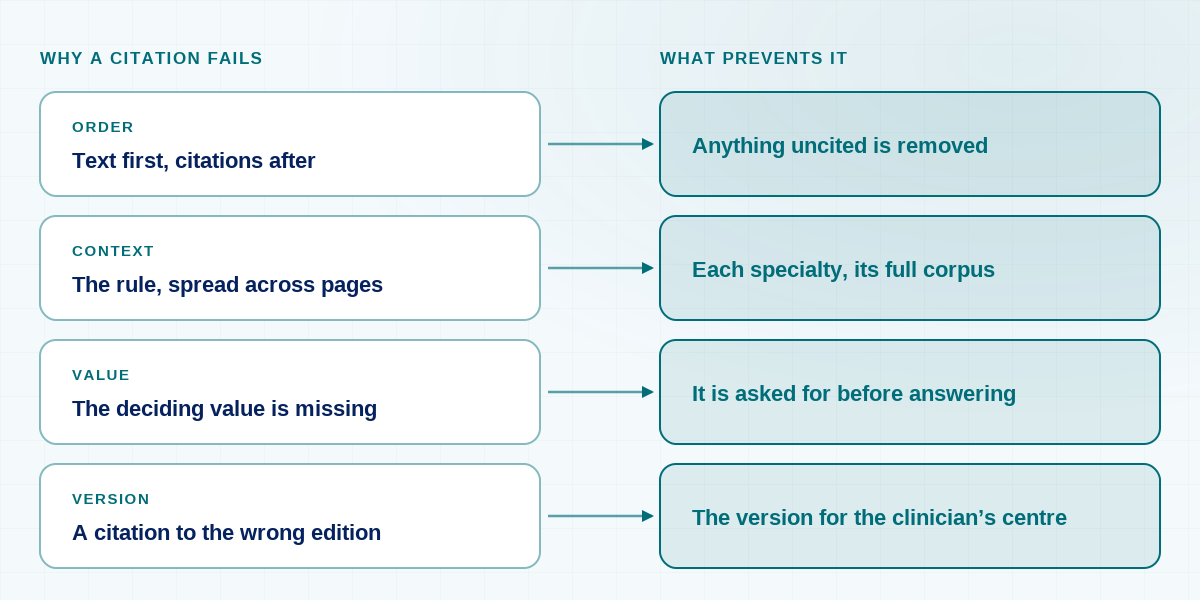
The first cause is the order of work. When the text is written first and the references are added afterwards, the citation proves that the document exists, not that it says what the sentence says. An answer like that can have every reference well formed and none of them checked.
The second is context. A clinical rule rarely lives in a single paragraph: the dose is in a table, the condition that limits it is two pages earlier and the exception is in a footnote. If the answer is built from loose excerpts, the dose can arrive without the condition that restricts it to a range of kidney function.
The third is the missing value. Many guidelines distinguish cases by a specific value, and the clinician's question does not always include it. Without that value, the answer averages the cases or picks one without saying so, and either way the citation supports a scenario that may not be the patient's.
The fourth is the version. The reference guideline, the regional protocol and the centre's adaptation may say different things about the same question. If a centre has adapted the referral criterion of the regional guideline, a verbatim citation of that guideline is still accurate and, in that centre, no longer describes the guidance in force. A citation that points to the wrong edition is well formed and, even so, is not the one that applies in that consultation.
What the guarantee has to cover
Each of those causes calls for a different condition, and all four have to hold at once. This is how we address it at BinPar, and it is what the video shows step by step.
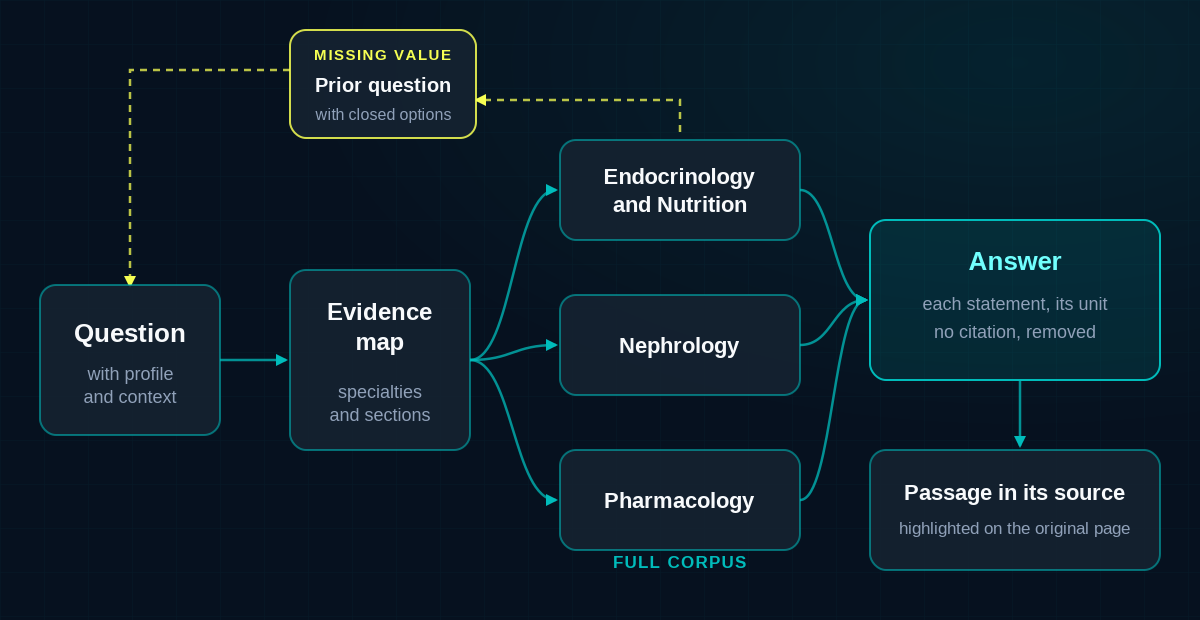
Each specialty, on its full corpus
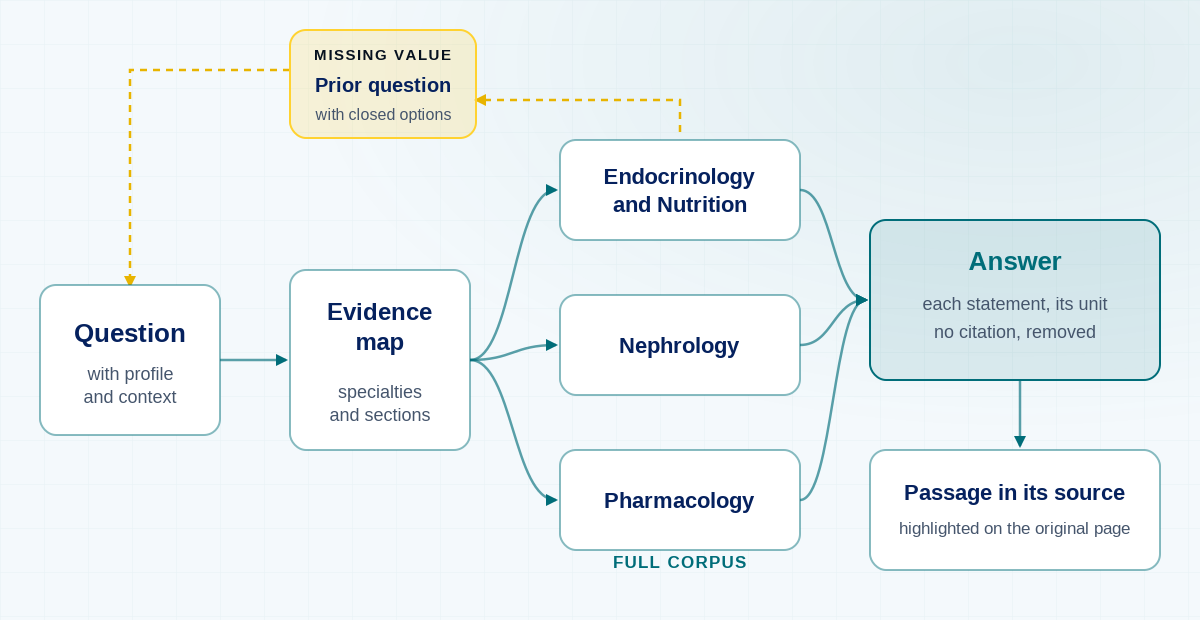
Before anything is drafted, an evidence map runs through the committee's corpora and flags which specialties cover the topic and in which sections. In the query in the video, the question goes to Endocrinology and Nutrition, Nephrology and Pharmacology, each with its own sub-query.
Each specialty is consulted on its full corpus, not on excerpts retrieved by a prior search, and in the version that applies to the clinician's centre: the common base plus the layers of their organisation. Consulting the whole corpus is what allows the dose to arrive with the condition that limits it, even when the two are on different pages. If the topic is not in its corpus, that specialty says so, and that absence is also part of the answer. Meanwhile, the clinician sees which specialties are being consulted and which pages have been reviewed.
The deciding value is asked for before answering
If the guideline distinguishes cases and the value that separates one case from another is missing, such as the glomerular filtration rate, the question reaches the clinician before the answer does, with closed options that can be answered in one click. That question asks for details of the case and never suggests drugs or doses. Once it is answered, the query resumes without repeating the work already done.
Anything without a citation is removed
When the answer is closed, each statement is linked to the exact unit of the corpus that supports it, and anything without support is removed. If the guideline does not cover something, the answer says so. General knowledge is added only when the organisation allows it, and always flagged as such.
The citation opens in its source
Any citation number opens the highlighted passage in a panel next to the answer. If the source is a PDF, the viewer shows the original page and indicates whether the cited text matches it verbatim. From there you can go back to the answer or open the full document.
A citation is useful when the clinician can open it, read the passage in context and check that it says the same as the sentence that cites it.
What the guarantee does not cover
A traceable citation shows that the guideline says what the answer states. It does not show that the guideline is the right one for that patient, or that its recommendation fits what the clinician observes in the consultation. That assessment remains clinical: the system orders the evidence and the clinician decides.
Nor can the answer go beyond the organisation's library. If the topic is not in any corpus, the answer declares it, and the solution is to add the missing source, not to ask more of the answer.
The prior question has its own limit. It only appears when the guideline explicitly distinguishes cases by a patient value. If a relevant factor is not a criterion in any guideline in the corpus, the answer will not ask for it, and providing it remains the task of whoever knows the case.
The verbatim-match indicator marks a review threshold. When the cited text does not match the PDF word for word (a converted table, a paragraph reordered in the edition), the original page is the reference and should be read before relying on the sentence.
Finally, rating each answer is the way to correct what fails, not a guarantee that nothing fails. An answer marked as not useful requires a comment, which reaches the editorial team so they can review the corpus.
Reviewable before convincing
The fluency of an answer says nothing about its reliability. What allows it to be defended before a committee or an audit is being able to walk the path backwards, from each statement to the passage and from the passage to the page. That path is visible evidence, and it requires decisions that do not show in the final answer: consulting each corpus in full, asking before assuming, removing what has no citation and showing the source without intermediaries. An answer that meets those four conditions may fall short if the library has gaps, but anyone can see where they are. For a healthcare organisation, that difference separates a tool that can be supervised from one that can only be believed.